I never liked the title, All I Really Needed to Know I Learned in Kindergarten. I can’t swallow the implication that the rest of our schooling was somehow a waste. (Trust me: It’s good you read beyond a kindergarten level; it’s good your doctor went to medical school.)
But I love the notion that fundamental experiences apply fundamentally—that we’re still using what we learned when we were 5 to do all sorts of important grownup stuff. I just happen to believe we go on having these fundamental experiences throughout our lives—and that our adult lessons can be just as useful as the golden rules we absorbed in kindergarten.

Bike racing is full of these lessons. And while our fitness might begin eroding almost as soon as we hop off the bike, these knowledge gains promise to be permanent. (They’re like riding a bicycle; you never forget.)
Here are my top three on-the-bike lessons I credit for making me a better husband. A better dad. A better guy with a job and a mortgage.
1. It’s OK to be fanatical.
Growing up in 1990s Nebraska, I’ve overdosed on superfandom. (In a personal Husker-fan low point, a recliner may or may not have touched the ceiling of my grad-school apartment in anger.) But gravel racing has brought me back around, teaching me that absurd enthusiasm still has its place.
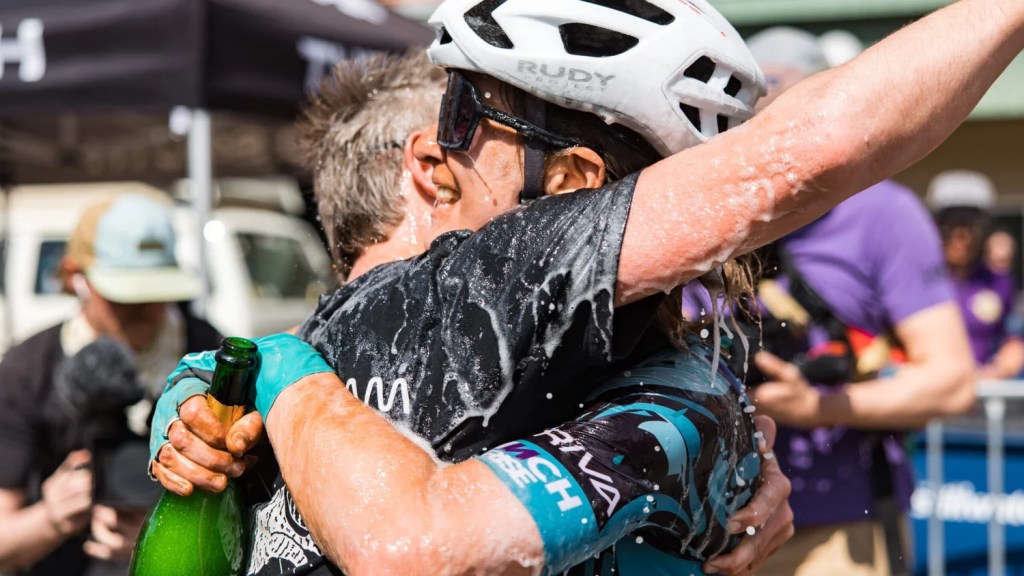

My marriage is one of those places where there’s no such thing as rooting too hard. When Beth took a chance and launched her own business last winter, I had the choice to clap politely or go friggin’ bonkers, paint my face and howl my support until my voice gave out. I picked the latter—because who else should be her biggest fan?

The greatest thing about being a Beth Brady superfan? She cheers back. Beth has spent years chasing the kids and me around countless gravel courses, shaking the Bisquick out of cowbells at us along the way—because who else should be our biggest fan?

2. Loosen your grip already.
The two least effective words in English might just be: Calm down. When I’m tense, nothing cracks my poise quite like a task that demands it. And gravel descents demand it.

Pointing my bike downhill over loose gravel is probably the scariest thing I do on a regular basis. Throw in a gusty Nebraska crosswind, and I get the full-blown fantods. Shaky hands won’t help. So I say the words: Calm down, Eric’s hands! And they shake harder for spite.
The only thing that’s helped is gravel’s greatest gift: repetition repetition.

Over and over, as my poise and I pointed downhill, I could slowly unpack my poorest instincts. Convinced I was about to draw a line in the gravel with my chin, I’d sit up high and bring my face as far from that belt sander as possible. To stave off any sideways shoves from phantoms or wind or loose cattle, I’d squeeze the juice out of my hoods. And. Just. Hang. On.
Eventually, the life lesson materialized: What makes you think you’ll make better decisions terrified?
From there, my elbows slowly softened. I weighted my pedals more, my bars less. I quit absorbing half the chatter my tires were willing to eat on their own if I’d just let them. I welcomed the physical stability that follows mental stability. And the fantods (mostly) cleared.
3. Pain isn’t special.
Pain is such an inward experience. We can describe it, but not even Bill Clinton can feel it for us. It’s ours alone.

That exclusivity leads to all sorts of human misunderstandings. We can let ourselves grow isolated, convinced in our throes that nobody else has ever hurt like this. Or we might be oblivious to pain in others, and do or say things we wouldn’t if we understood what they were going through.
The “fun” of endurance sports rests in playing around with our pain thresholds, and understanding at an athletic level how our pain works. Training adds both fitness and familiarity, so the point at which pain becomes unbearable or frightening slides satisfyingly to the right on the scale as our strength grows. Racing in groups, we also learn comparative suffering. Accrue even a little time on the delivering and receiving ends, and you see pretty quick: Nobody on course gets out clean.
What develops from here isn’t sadism. It’s perspective. You can sit in a difficult meeting and think: I know how to handle this. I’ve hurt worse having fun on Saturdays. And that realization runs pretty close to a superpower.
A while back, my youngest daughter had an unfortunate run-in with a bat in our house. To be safe, she needed a series of not-fun rabies injections. This vaccine has a painful reputation. Beth asked how bad they hurt, and when Sydney answered, the clouds broke above me and I heard angels sing.
She said, “Well, it definitely hurt less than a cross country meet.”

 Dirt Tan Bike Club