
Ride your bike long enough across any rural stretch of the Great Plains, and just about everything will grow personified.
I’m convinced by now that my bike has strong opinions about mud. That farm dogs and cattle are capable of casual conversation. And that the dead racoon up ahead is just somebody having a slightly worse day on the road than I am.
I can’t be the only gravel rider who thinks like this. That cottonwoods like the feeling of birds in their hair. That soybeans close their eyes beneath the pivot and gasp as the shower comes down. I mean, how could they not? That’s just how the world works.
But nothing on a country road takes on personality like an abandoned farmhouse. A collapsing country church. They are, like the gravel cyclists racing past them, emptied out. Tilted. Staving collapse in a paint-peeling effort, equal parts silly and brave.

These falling houses grab at my curiosity like cockleburs as I ride past. Each empty one a library strewn with mice and unread memoirs. I’ll ride for miles thinking about the girl through the broken window upstairs, and whether the school dance in 1946 went this way or that. Was she happy up there? What was the thing that sent her family packing? How long did they hold on? And what was it like, moving on from exactly here?

I came across a book of photographs and poems recently that raises a voice for Nebraska’s sinking farmhouses. I wound up reviewing that book for work. And while it has precisely nothing to do with gravel cycling, the book has everything to do with the rural spaces where we ride. How those places came to look like they do.
It’s a book that matters to me as a cyclist as much as it matters to me as someone with deep family connections here. So I asked permission from its coauthors to rerun that review for you here. I appreciate their green light.

Each photo here is from this 2023 book, and is used with permission. If you enjoy Michael Farrell’s work, I encourage you to check out his 2019 exhibit on Nebraska’s Bohemian Alps, which should look pleasantly familiar to folks who’ve ridden Gravel Worlds or the Bohemian Sto Mil. You can see his physical photographs in Lincoln at WallSpace-LNK over on 17th and Sumner. It’s worth your time.
Cyclists are just as likely to appreciate Twyla Hansen’s poetry as it climbs and coasts over grassland with a smooth cadence any rider would admire.
Farrell and Hansen have an eye for the beauty of this landscape. But that eye never loses sight of the ugly industrial forces that squeezed so many small family farms out of operation, and spat those families out of their homes.
Anyhow, here’s that review, featuring far more photos than we had room for in my employer’s print magazine.
Seen in OTOE County
Photographs by Michael Farrell / Poems by Twyla M. Hansen
Michael Farrell Photography and Art, 2023 / 100 pages / $40
I can never not be nostalgic for Otoe County, Nebraska.
My parents grew up on small farms there. I spent my first dozen Christmases (and Groundhog Days) at my grandmother’s in Unadilla—Nebraska’s Groundhog Day capital. Flew my first kite there. Caught my first 400 bluegill in ponds thick with red-winged blackbirds.
So when Michael Farrell and Twyla Hansen’s book of photos and poems, Seen in OTOE County, landed on my desk, I said, “Yes, ma’am, take me there.” Because I’ll always want to go back to my familiar.
Hansen’s poetry excites a similar, welcome familiarity with me. She served for five years as Nebraska’s state poet, filling that post after the death of her teacher and friend, Professor of English William Kloefkorn. Their work shares a root system of place and pace and principle.
Many years earlier, Kloefkorn and Hansen were coworkers, with Hansen serving as Nebraska Wesleyan’s groundskeeper. Each summer on this campus, you can still find colorful traces of Hansen’s early work—or rest in the shade of what she planted.
This book adopts a related mission; it seeks evidence of Otoe County’s earlier work—traces of people and families and ways of life that once bloomed here, but didn’t stay.
Farrell and Hansen aren’t pining for my lost childhood. And their work in this important book is free of the sticky nostalgia that smears my lens. Instead, they’re searching for traces of a vanishing system of small family farms that once sustained my immediate ancestors.
Those traces are most poignant in photos of the decaying country churches and abandoned farmhouses that dot our countryside.
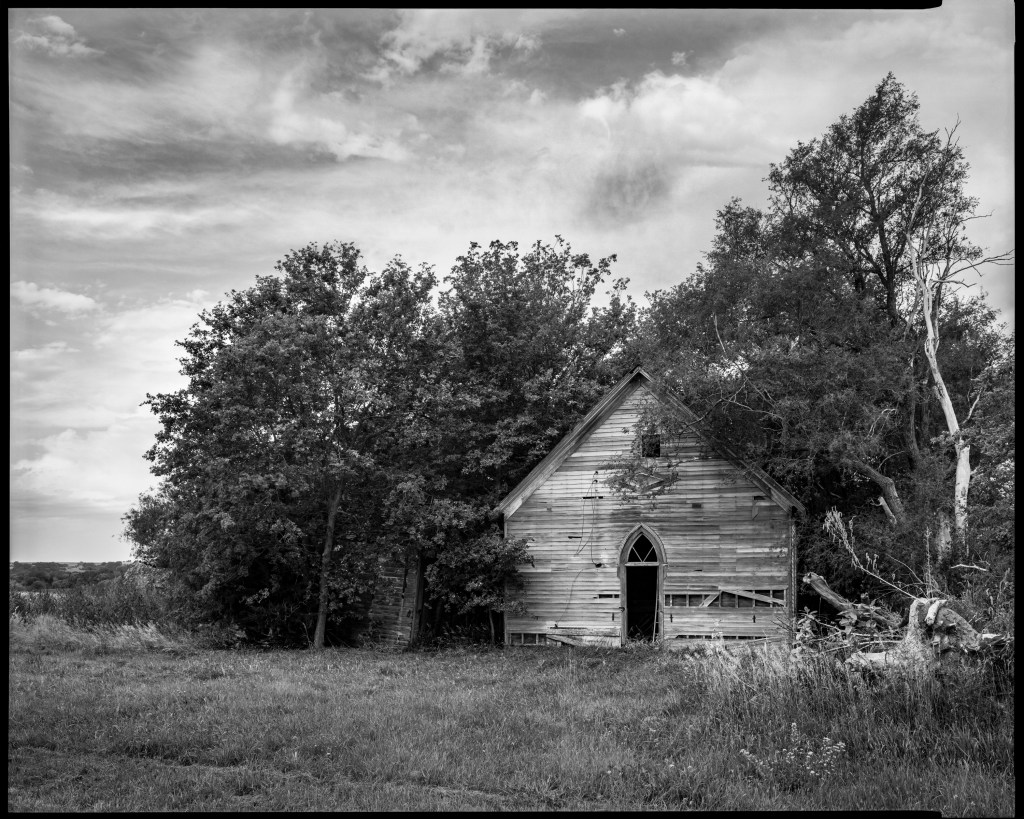
Then there are Farrell’s photos of Otoe County fences, blown and grown over. In them, the property lines between public and private Nebraska—our past and our present—come into a weedy tangle. Again and again, these photos slide us offroad, and we find ourselves knee-deep in nettles. There’s a feeling here of old boundaries crossed, and of a quiet, unfolding trespass.

In “Dead End Plank Bridge,” Farrell puts us on the side of the creek we’ve been warned against, and there’s no easy way back.
You won’t find a single person in these photos—only the traces of people who are gone. More than landscapes, these photos become portraits of absence.

That’s not to say life is gone in Otoe County. Countryside Bank remains open on Unadilla’s Main Street. Four miles south, my cousin raised her three kids in the same farmhouse where my mother learned to walk. But the farmland around it is leased to larger operations. And my mom’s country schoolhouse is long gone.

Hansen’s poem, “A Certain Sadness,” begins:
There’s a certain sadness now to the rural landscape:
road after gravel road past the remnants of farmsteads
and windbreaks and buildings.
She’s honest about the causes of this decline in “Leaning House of Rural.”
Admit it: this was predictable here in the corn belt,
in the deep thick of industrial ag, the needle of
government guarantees. We shake our heads, yet
let status quo rule. In back, the shed looks alarmed.

The works of art in this book are not nostalgic. They are, like Otoe County itself, weathered, honest, beautiful—and unblinkingly severe.
When I think of Nebraska’s pastoral past (and my happy childhood inside it), I want nothing more than to hear: It remains.
Farrell and Hansen have the courage to show us instead: Its remains.
Hansen ends her poem, “An Oft-told Story”: “Are you disturbed yet?”
 Dirt Tan Bike Club