On day five, when the road turned easy, Marty coasted up alongside me with a question. “What’ll you say when people ask about this?”
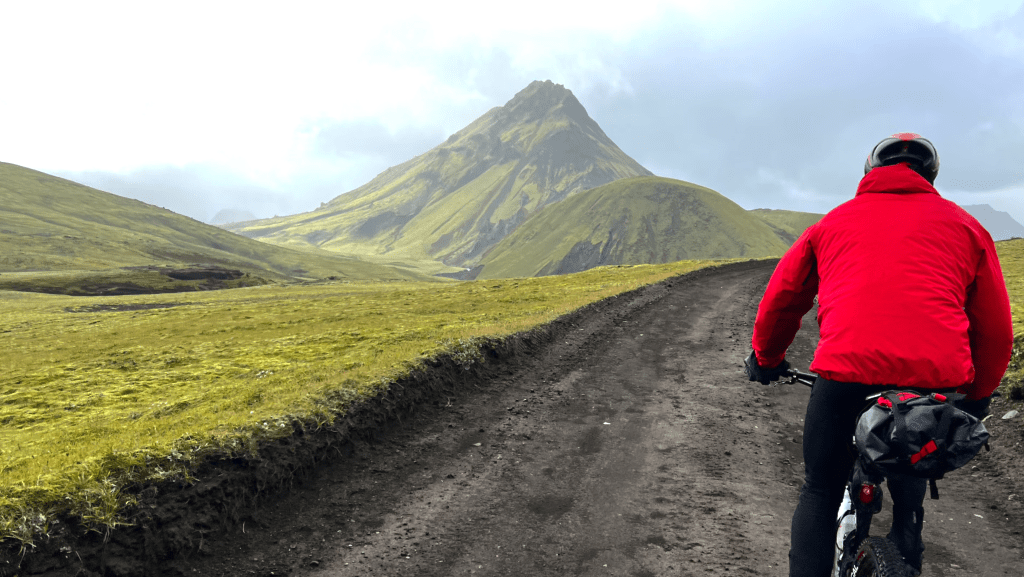
“This” was our eight-day trip bikepacking and hiking in Iceland. The ruggedness and the weather. Also, the awe and the impossible beauty.
“Like, someone you care about. Do you tell them to come here and try this?” (For Marty, “someone you care about” meant “not us.” Toward Mike, Addison and me, Marty was beyond caring. As in: I love you. Also, shut the hell up and climb this active volcano.)

My initial answer: Yeah, I’d happily put just about anyone up here.
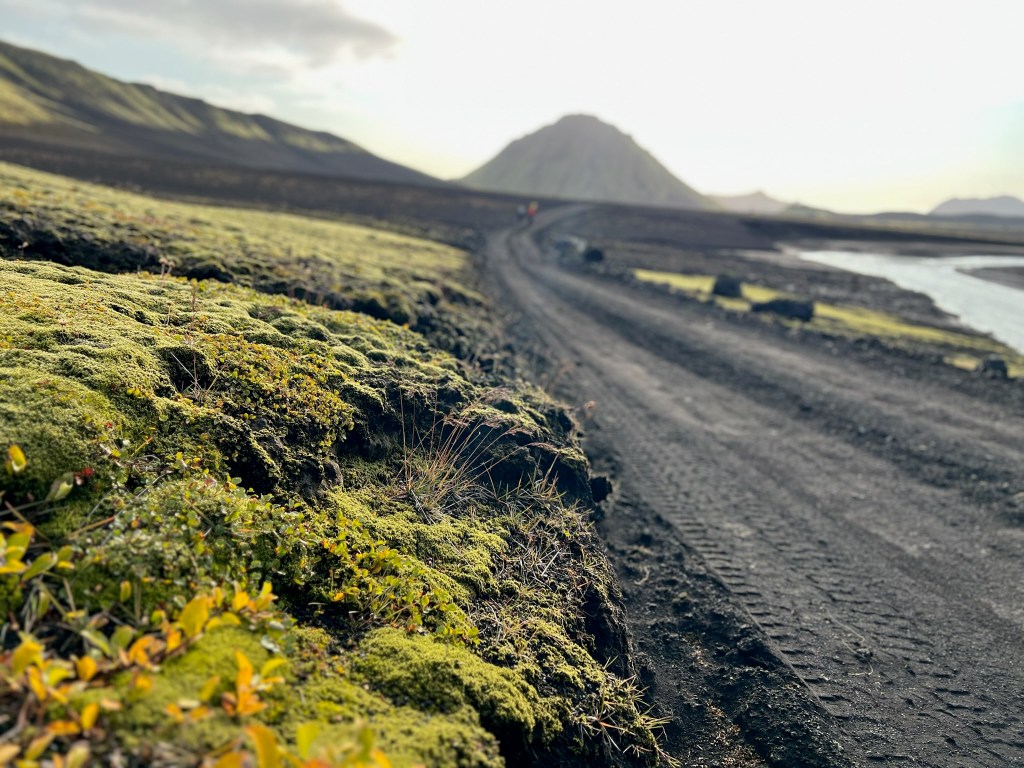
The sun was out for once, shining on us as we rode along the edges of three gorgeous, monochromatic landscapes—black, lime and dirty white. Our last 10 miles had covered nothing but forgiving lava sand in otherworldly, sweeping black dunes. Behind us and to our left, this blackness gave way to another planet’s giant, lime-green cones of moss-coated volcanic rock—the rounded, sheep-grazed tips of God’s green crayons. And in the distance to our right: a wall of glacier ice—the long white forearm of Mýrdalsjökull.
Who wouldn’t love to be put right here, in the mossy seam of God’s coloring book?


But there’s no putting anyone up here. You can only arrive. And our arrival had involved cheek-flapping wind. So much rain. (This part of Iceland soaks up nearly 10 inches a month.) And hail. Blowing sleet. Snow. And a difficult mountain pass.

We’d speak later to a local hotelier who loved this route into the highlands. He’d ridden it on horseback. Or, more precisely: horsebacks. His groups brought three horses per person, preserving them into the rugged highlands with a rotation: Carry a rider. Carry gear. Recover.
Would it be friendly to send a friend into this—to bike in one of the most strikingly beautiful landscapes on Earth, along a course that could crack a horse?
I didn’t quite know how to pull that question apart.

***
Icelandic itself is a heavy pull—a rocky, Germanic language thick with triple compounds. Icelandic chunks its meanings together and counts on you to pull your weight. As a result, its native speakers carry around these fit, disciplined tongues. They’re a people who dot their o’s and cross their d’s.
I wanted to be proper with their nouns—to call Iceland’s people, places and things by their names. But I couldn’t. I’d hear the words, repeat them, and immediately lose their threads. There was no pulling them back.
We’d set out on Fjallabadsleid only to feel it crumble beneath us into F210—a near-word, kinder and colder. (In the language of Icelandic roads, an F designation was clear enough. F = 4 wheeldriveonly. Try it in a city car, and get effed.)

***
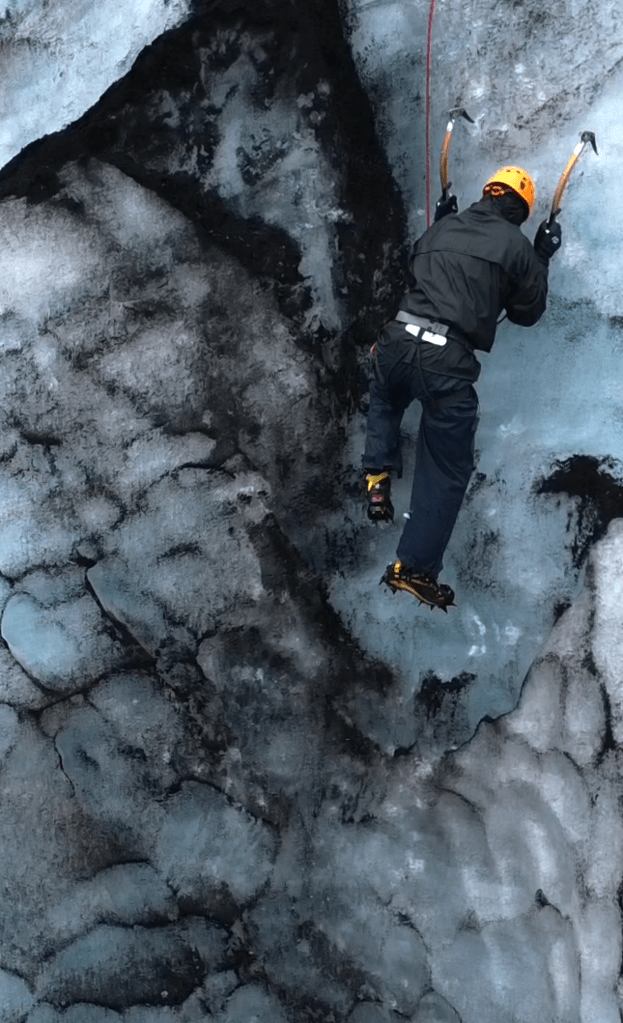
On our last full day in Iceland, we traded pedals for crampons—a new language for the feet. No climber, I put them on and slurred in all the ways you might predict.
Our glaciertourguide simplified his name to Sam as a practical mercy. Sam explained the glacier’s compound name to us as he calmly clipped and rolled two strips of gauze to cork my ice-smashed nose.
Sól: sun.
Heima: home.
Jökull: glacier.
Sólheimajökull: the sun’s home glacier.
“Stick these up there good and pinch down hard.” He further described this glacier’s name with two more compound words. “It’s bullshit,” he said.
“Sun glacier? It rains here 200 days a year.”
On the first day Sam becomes president, he said, “I’m renaming this thing Cloud Glacier.” Torrent Glacier. Home of the Incredible Shrinking Rainy Glacier.
“I go on holiday and I come back and it’s all different.” He gestured toward the dinnerplate of bloodied ice between my steakknifeboots—a red spot today’s rain was already pulling toward pink. “All this is torn up since June. This’s where the glacier’s pulling itself apart.”

We decided my nose wasn’t broken. The bleeding had kind of stopped. When I pushed it back and forth, I didn’t cry much and it didn’t pull apart. So that was good. I could keep going.
We took turns rappelling into a deep crevasse and climbing out. The climb itself was visible to Sam at the top, and to Addison with the camera. My turn went as well as you’d predict. The rope and my harness also behaved predictably.
“How’d that go?” Mike asked when I was done.
“I died like three times down there.”
He nodded. “And you made it out.”
So that was good. I could keep going.
Soon, Addison marched over, grinning. I knew he had pictures of my awkwardness. Video even. “Yeah, nobody needs to see that,” he said. That was also good. I could keep going.

***
Iceland is, to me, that best place to keep going. To just pull and see what happens. In the span of a bike ride, the weather here will change, and change, and change again. So will the rules.
I outweighed my friends on this trip by about 50 pounds apiece. And the rules of physics normally make sure I feel this difference every time the road tips uphill. But throw 50 pounds of gear on everyone’s bike, and the formulas change. (Fifty pounds might be an overstatement, but it simplifies the math.)
To them, that weight was a 30% increase. To me, it was more like 20%. And suddenly, being a thick lummox pulled from a liability into an asset. Less encumbered than my unbearably light friends, I lumbered up the pass near Einhyrningur (unicorn mountain) on my own—feeling, well, a little like a mythical creature at home on a magic mountain.
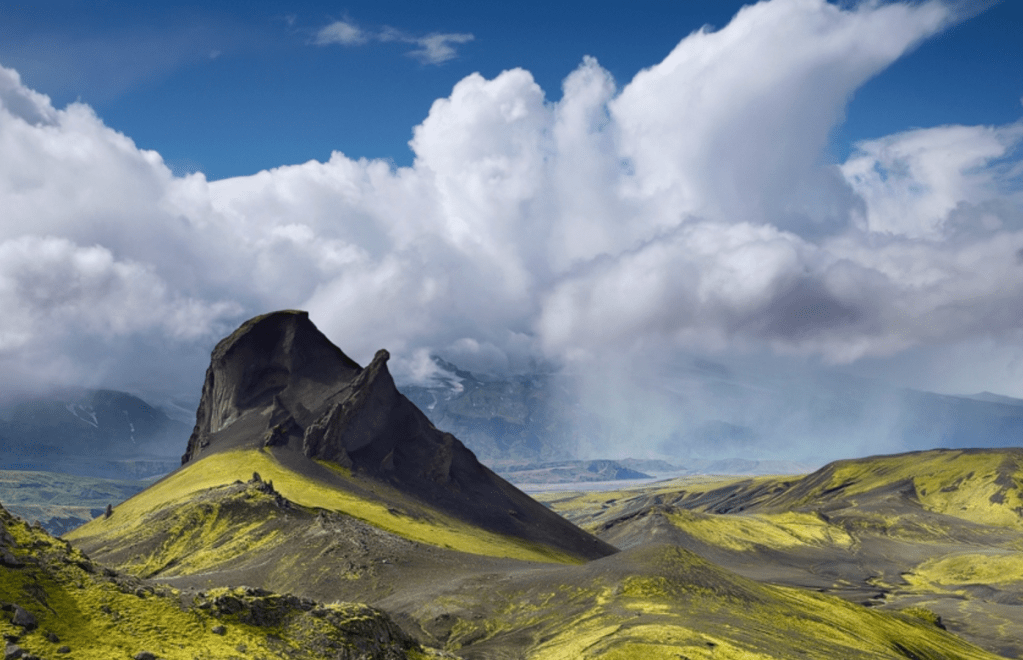
Iceland could pull the same sort of switcheroo with the earth and air. One of these sky-highland F roads we rode—I can’t remember which—had been closed just a week or two before. And Marty had called to confirm whether our route was passable. The road had flooded out a while back, a woman with the park service told him, but it was clear now. You’re good.
Where I grew up, the sky is generally responsible for floods. And as much as it rained here, it felt like no stretch to blame my usual suspect for this one. But Iceland could pull its floodwaters from the opposite direction. And the event that had rendered our road briefly impassable was a geothermic flood—a new term to me. Here, the indigestive land regularly burps a volcanic heat. And when that heat bubbles up beneath a glacier, it boils off its bottom side, sending a rush of unrainwater down the mountain.

In this way, Iceland’s eruptions can create new land from two downhill directions: by spilling fresh lava, or by sliding old silt.

This was all new territory to me. It made Iceland often feel like another planet, with its own peculiar gravitational pull. And I felt woozy more than once in the highlands, in a way I can only call astronautical.
An astronaut can’t help but feel big stepping into a tavern. There’s a chest-thumping exclusivity in the title. And you can bet if NASA allowed gerunds on its business cards, I’d make sure mine read: Eric Wendt, fucking astronaut.
But the nature of their work comes with an equal and opposite pull. And an astronaut can’t help but feel small slipping outside the space station. A space walk comes tethered to a shrinking humility—a recognition of smallness. It’s clear out here: We’re a speck’s freckle.

Iceland worked on me in the same way.
Sure, this trip involved some rugged stuff. Stuff that plays well on Instagram. Stuff that lends itself to the thumping of chests. You want to come up here, rookie? Pack a lunch and your best pair of insulated big-boy pants. Cuzyoumightnotbeastoughasus.
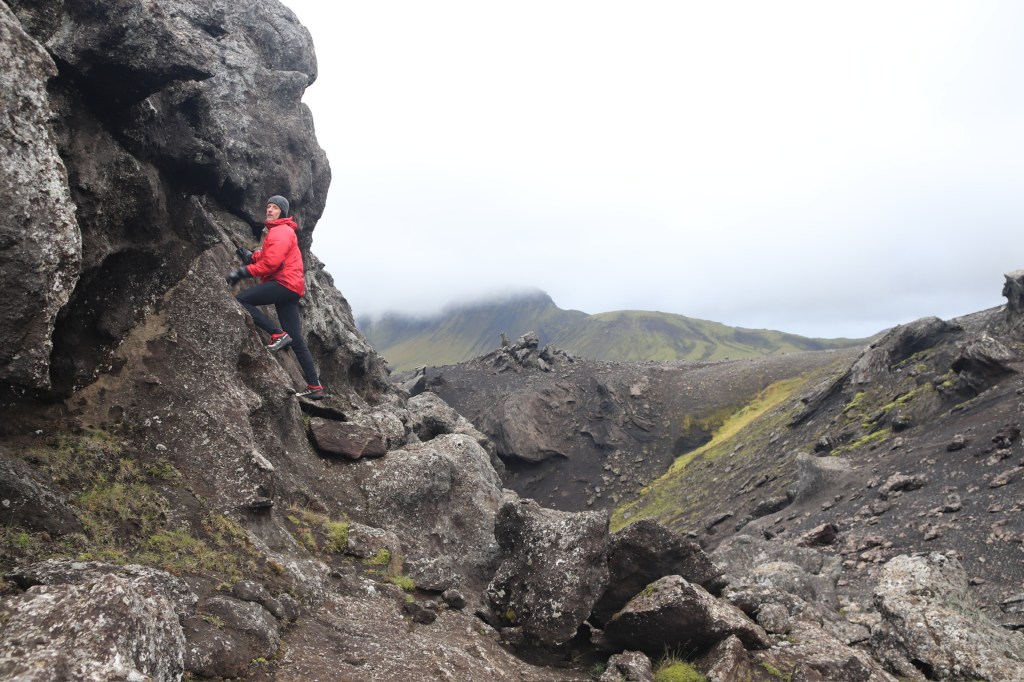
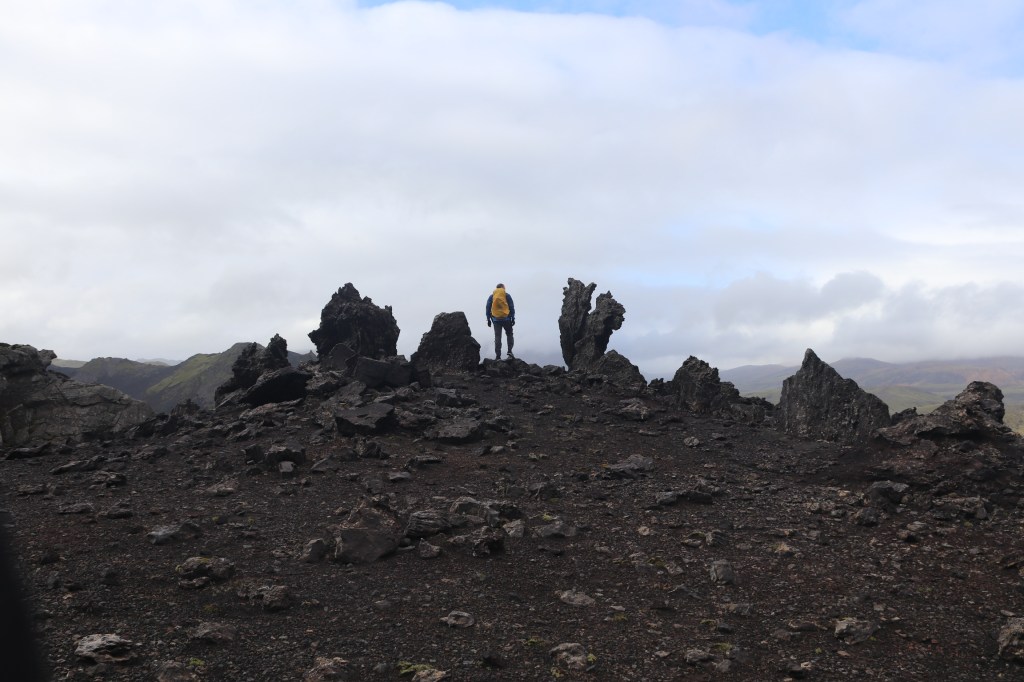
But this is the tug of false ego. Truth is, big-man toughness has never taken me half as far on these adventures as just a little humility will. And whatever inflated tough-guy hot air I carried onto that glacier came squeaking out my nose in less time than it takes to snag a crampon on the leg of my insulated pair of big-boy rain pants.
Bikepacking in Iceland isn’t about strong or not strong. Fast or not fast. It’s about being OK with small steps. With setbacks. With being uncomfortable for a good while—whether that’s from wetness, or coldness, or embarrassment. All of that passes like wind.
Then it’s only: Are you still pulling? Are you sensitive to what’s holding together in your life—and to what pulls apart?

Most times, I find the gift in what holds together: Your wits. The support and positivity of your good-humored and generous friends. The plane that lands you safely on a windy runway in Reykjavík.
And sometimes, the gift comes in what pulls apart into its better pieces. The sun. And the home. And their glacier.
I’m thankful to Iceland Airlines for carrying my friends, our bikes and me, there and back, in one piece. I’m just as thankful to have those quintessential things leftover when each of those syllables pulls apart: This ice, and land together. Its air and its lines.



***
For our last stretch on the bike, it rained all day. And we rolled across our personal finish line in Vik as wet as it gets—done and happy and happy to be done. We took shelter beneath a small overhang outside the hotel and tended to our tired bikes, turning off our lights, pulling off bags.
An older gentleman stepped out of the hotel and paused beneath the overhang. He looked at us, at the rain, then back at us again. He shook his head. “I don’t know whether to call that incredible or crazy.”
Me neither, I told him. Some things don’t pull neatly apart.
 Dirt Tan Bike Club
2 thoughts on “Bikepacking Iceland: Things Pull Apart”